Most homes in Sioux Falls benefit from a water softener, because city water here tests as very hard by the US Geological Survey's scale. Whether yours needs one, and what size, comes down to a water test: it tells you how hard your supply actually is and whether iron or sulphur needs a separate treatment stage.
Why This Matters to Homeowners
Hard water does not make anyone ill. It costs money slowly, in ways that are easy to miss until something fails.
The minerals that leave white crust on a shower door form the same deposit inside a water heater, a dishwasher, a washing machine and every valve and cartridge in the house. Scale on a heating surface acts as insulation, so the appliance works harder for the same result, and parts with moving seals wear out sooner. Most of the value of a softener is protecting equipment you have already paid for.
How Hard Is Sioux Falls Water?
The City of Sioux Falls publishes test results for the water it delivers. Its 2020 finished water quality summary lists average total hardness of 259 mg/L (about 15 grains per gallon) for water from the city's own plant, and 181 mg/L (about 10 grains per gallon) for water supplied through the Lewis and Clark system (City of Sioux Falls, Finished Water Quality 2020).
For scale, the USGS classes water above 180 mg/L as calcium carbonate as very hard, 121 to 180 as hard, and 61 to 120 as moderately hard (USGS Water Science School, Hardness of Water). Both Sioux Falls supplies sit at or above the very hard line on average, and the city's results range higher on some days.
Private wells are a different picture
Acreages and farms on private wells around Brandon, Hartford, Tea and out toward Madison and Brookings vary from one well to the next. Many have hardness on top of iron, and some have sulphur. A neighbour's result tells you little about your own well, which is why the test matters even more outside city limits.
Signs Your Home Would Benefit From a Softener
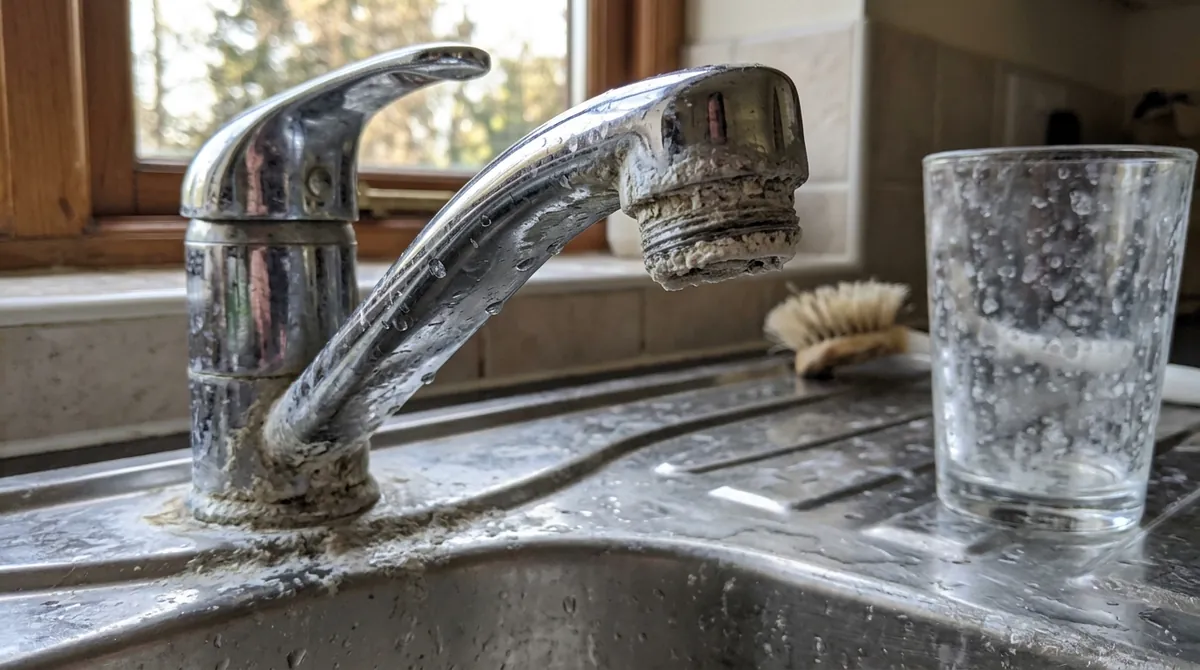
- White, chalky buildup on faucets, shower glass and dishes.
- Soap and shampoo that will not lather properly, so you use more of both.
- Laundry that comes out stiff or greyish.
- A water heater that rumbles, or one that failed well before its expected age.
- Kettles and coffee makers that scale up within weeks.
- Low flow at fixtures in an older home, where scale has narrowed aerators and valves.
If you already have a softener and still see these, the unit may not be doing its job. Common causes are exhausted resin, a valve set for the wrong hardness, or salt that has formed a crust in the brine tank so the unit is not regenerating.
When a Softener Is Not Enough
A softener removes hardness. It is not a cure for everything that can be in water, and this is where buying on assumption goes wrong.
- Orange or brown staining usually means iron. Small amounts can be handled by some softeners; higher levels need a filtration stage ahead of it.
- A rotten-egg smell, especially from the hot tap, points to sulphur, sometimes reacting with the water heater's anode rod. That needs its own treatment once it is identified.
- Taste or other concerns on a private well call for testing beyond hardness before choosing any equipment.
This is why we test first. Hardness, iron and smell are three different problems with three different answers, and a softener sold for a problem it does not treat is money spent for nothing.
Salt-Based Softener or Salt-Free Conditioner?
You will see both offered, and they do different things.
Salt-based softeners
A salt-based softener exchanges the hardness minerals for sodium as water passes through a resin bed, then flushes them out during regeneration. The water leaving it is actually soft. You add salt to the brine tank and the unit needs a drain and a power outlet nearby.
Salt-free conditioners
Salt-free systems do not remove the minerals. They are designed to change how the minerals behave so less scale sticks to surfaces. They need no salt and no drain, but the water is not soft, and results on very hard water vary.
At the hardness levels Sioux Falls water shows, a correctly sized salt-based softener is the option that reliably removes hardness. A conditioner can make sense where a drain or salt is impractical, as long as you know what it does and does not do.
How a Softener Should Be Sized and Set Up
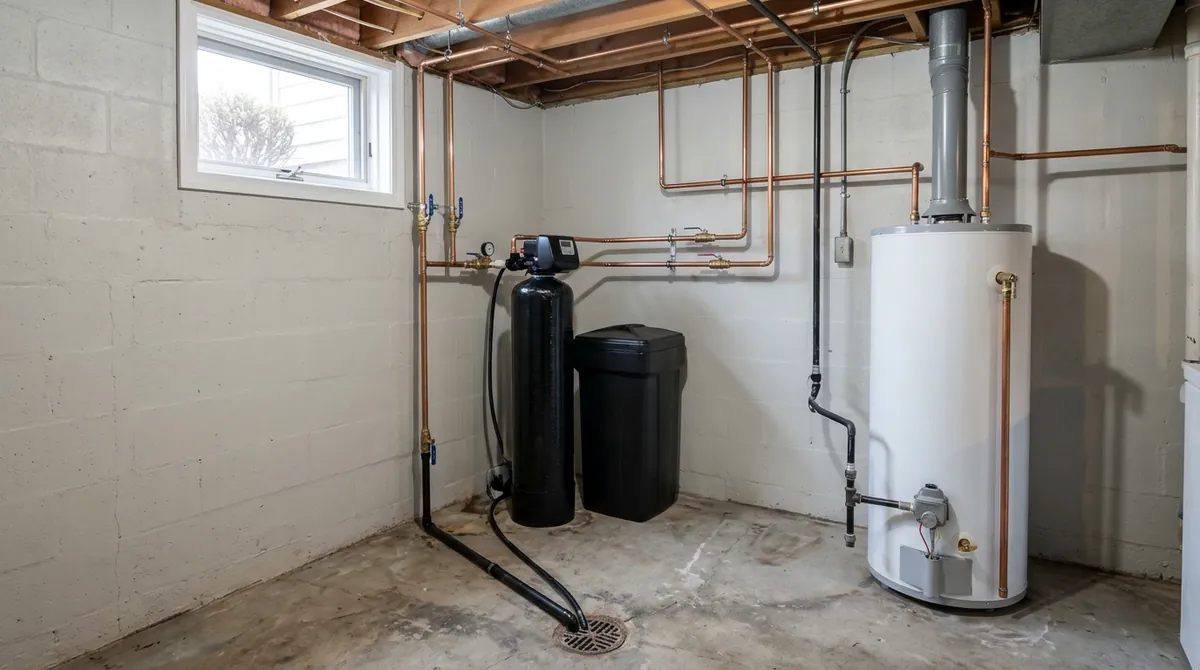
A softener that is too small regenerates constantly and wears out; one set for the wrong hardness lets hard water through. Getting it right takes four pieces of information:
- Measured hardness, in grains per gallon, from a test of your water, not a guess about the area.
- Household water use, based on the number of people and fixtures.
- Iron content, because iron adds to the load the softener has to handle.
- Peak flow, so the unit does not drop pressure when two showers and the washer run together.
Installation matters as much as the equipment. The unit needs a bypass so it can be serviced, a proper drain connection with an air gap, and programming to the measured hardness. It should be checked through a full regeneration cycle before anyone leaves.
What Affects the Cost of a Water Softener
We do not quote numbers in a guide, because the right system depends on your test result. What moves the price:
- What is in the water. Hardness alone is the simple case. Iron or sulphur adds a filtration stage.
- Size of the household. Capacity and flow rate are sized to demand.
- Existing plumbing. A house with a softener loop already in place installs faster than one that needs a loop, drain and outlet added.
- Well or city supply. Wells vary more and often need filtration ahead of softening.
- Replacing or servicing. An existing softener that has stopped working is sometimes a repair, not a replacement.
Need Water Treatment in Sioux Falls? Gold Standard Plumbing & Heating Is Ready to Help
Gold Standard Plumbing & Heating is locally owned, licensed, bonded and insured, with manufacturer-certified training on the equipment we install. Every system starts with a water test, for city supply and private wells alike, and existing softeners are serviced as well as replaced. You can read more on our water softeners and water treatment in Sioux Falls page, and about protecting your tank on our water heaters page.
Call us at (605) 530-6950 or contact us to book a water test in Sioux Falls, Brookings and the surrounding towns. We answer weekdays from 7:30 am to 5 pm.