

A leaking water heater can be repaired when the water is coming from a fitting, a valve or the drain valve, and it needs replacing when the water is coming from the tank itself. Where the leak starts decides the answer, so finding it is the first job, before anyone talks about a new unit.
Why This Matters to Homeowners
Most water heaters in Sioux Falls, Brandon, Harrisburg and Tea sit in a basement or utility room, often next to a finished wall, carpet or storage boxes. A slow drip at the base of the tank can go unnoticed for weeks, and by the time someone sees it the damage is in the flooring and drywall rather than the heater.
It is also an appliance you lean on every day. The U.S. Department of Energy says water heating accounts for nearly 20% of the average home's energy use and is typically the second-largest energy expense in a home, after heating and cooling (U.S. Department of Energy, Home Upgrades). A tank that is leaking, scaled up or running hot is costing you money as well as water.
The good news is that plenty of leaks are not the tank. A loose union, a worn drain valve or a relief valve doing its job can all put water on the floor, and all of them are repairs.
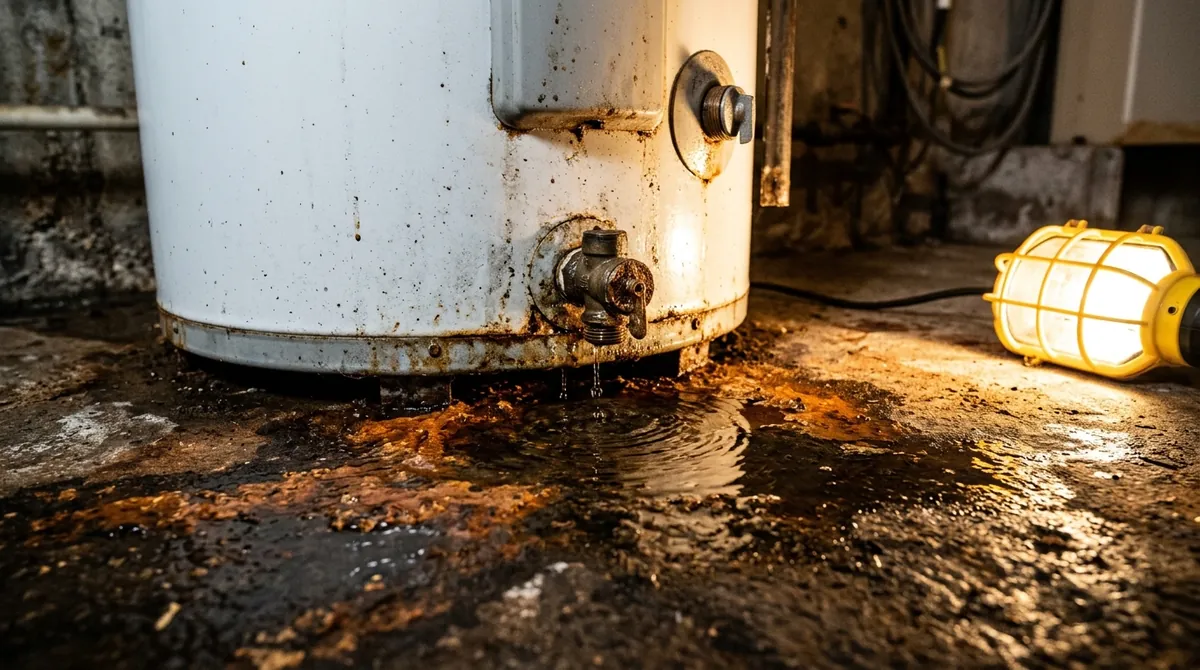
What Should You Do Right Now?
Before working out the cause, stop the water and make the unit safe:
- Close the cold water supply valve. It is on the cold line coming into the top of the tank. Turning it off stops the tank refilling, which slows or stops most leaks.
- Turn off the energy. On a gas unit, set the gas control to off or pilot. On an electric unit, switch off its breaker. An electric element that runs in an empty or draining tank burns out.
- Move anything that can be damaged. Boxes, rugs and stored items near the base of the tank.
- Do not open the relief valve or try to drain a hot tank yourself. The water inside can be scalding.
- Call rather than emailing. A leaking tank does not wait for a reply.
If the water is coming from the tank body and you cannot close the supply valve, shut off the main water to the house.
Where Is the Water Coming From?
Dry the area with a towel, then watch where fresh water appears. Leaks fall into five places, and each one points to a different answer.
The cold or hot water connections on top
Water running down the outside of the tank from above usually starts at the pipe connections, unions or the flexible connectors on top. These loosen or corrode over time. Usually a repair: the fitting or connector is replaced and the joint tested.
The temperature and pressure relief valve
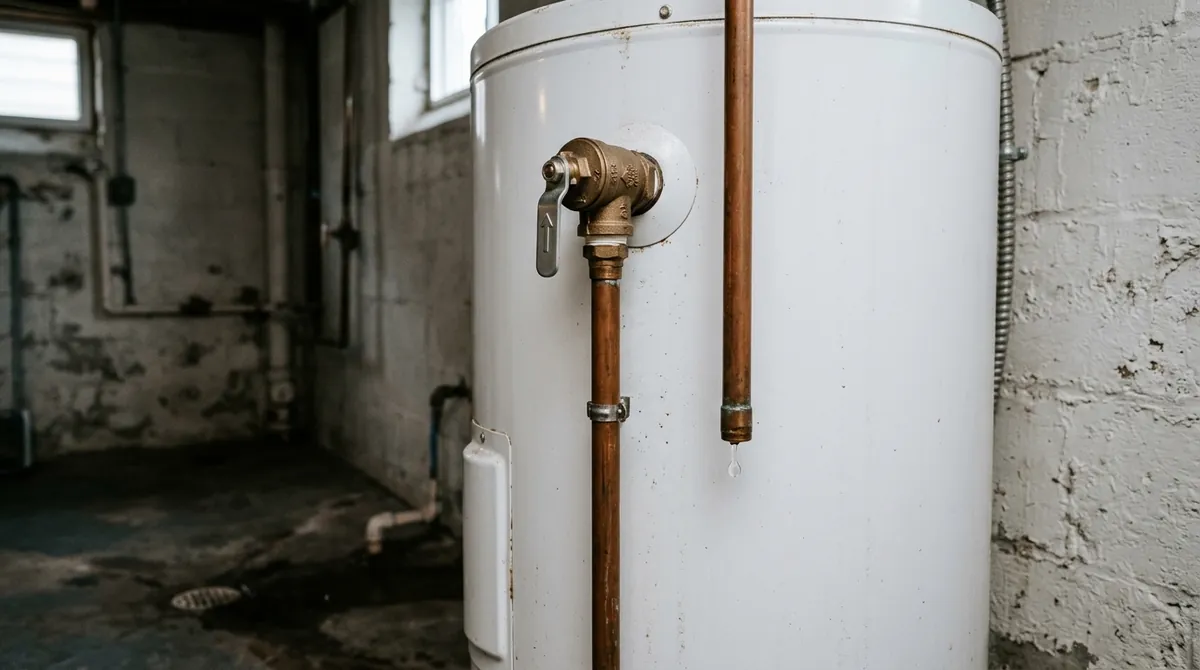
This is the valve on the side or top of the tank with a pipe running down towards the floor. If water is coming out of that pipe, the valve may be worn, or it may be doing exactly what it should because the temperature or pressure in the tank is too high. A repair, and a warning: the valve can be replaced, but the reason it opened needs finding. High pressure in the house or a missing expansion tank are common causes.
The drain valve at the bottom
The drain valve near the base is used to flush the tank. Older plastic valves can drip, especially after years of sediment passing through them. Usually a repair: the valve is replaced, and it is a good moment to flush the tank.
Condensation or another pipe nearby
A cold tank filling with fresh water can sweat, especially on a gas unit in a cool basement. A nearby supply line, softener or floor drain backing up can also leave water by the heater. No repair to the heater at all, once the real source is found.
The tank itself
If water is seeping from the bottom seam, from under the jacket or from the tank wall, the inner tank has corroded through. Replacement: no repair fixes a tank that is leaking from its body. It will get worse, and tanks that leak rarely stop. They fail.
When Is a Repair the Right Call?
Repair makes sense when the leak is at a part that can be replaced and the tank is in good shape. Elements, thermostats, thermocouples, valves and anode rods are all replaceable. On a unit under about eight years old with a sound tank, a repair is normally the better spend.
A good repair also deals with the cause. A relief valve that keeps opening points to a pressure problem. A drain valve clogged with grit points to sediment. Fixing the part without looking at why it failed means another call in a few months.
When Does Replacement Make More Sense?
Replacement is the answer when:
- The tank body is leaking. There is no repair for a corroded inner tank.
- The unit is past about ten years old. Most tanks last eight to twelve years here, and a leak on an older tank is often the first of several problems.
- The hot water is rusty or metallic. The lining or the anode rod has gone, and once the tank itself corrodes it cannot be saved.
- It rumbles or pops while heating. That is water boiling under a layer of sediment. Flushing helps early on; past a certain point only replacement does.
- Repairs are stacking up. A second or third repair in a short time on an ageing unit is usually money better put towards a new one.
If you are leaning towards replacement, our guide to water heater replacement cost in Sioux Falls explains what moves the price.
How Hard Water Changes the Answer Here
Hard water is the main reason water heaters fail early in eastern South Dakota. Minerals drop out of the water as it heats and settle on the bottom of the tank, where they insulate the burner from the water it is meant to heat. The tank works harder, runs hotter at the base and corrodes sooner.
That has two effects on a leaking heater:
- Sediment wears drain valves and relief valves faster, so small leaks at those parts are common and worth fixing promptly.
- Sediment shortens tank life, which pushes an older unit towards replacement sooner than the label suggests.
On acreages and farms with well water, iron and sulphur add their own wear. A rotten-egg smell from the hot water usually means the anode rod is reacting with sulphur, and a different rod normally fixes it.
If your water is hard, a softener ahead of the new heater is worth considering. It costs more up front and extends the life of the new unit. Our post on whether you need a water softener in Sioux Falls covers how to decide.
What a Replacement Involves
A like-for-like tank swap takes about 3 to 5 hours, including draining and removing the old unit. A tankless installation takes about a day, longer if the gas line or venting needs changing.
The work usually includes:
- Draining, disconnecting and removing the old tank.
- Setting the new unit, sized to how much hot water the house actually uses, not just to what was there before.
- Connecting water, gas or power, and venting on gas units.
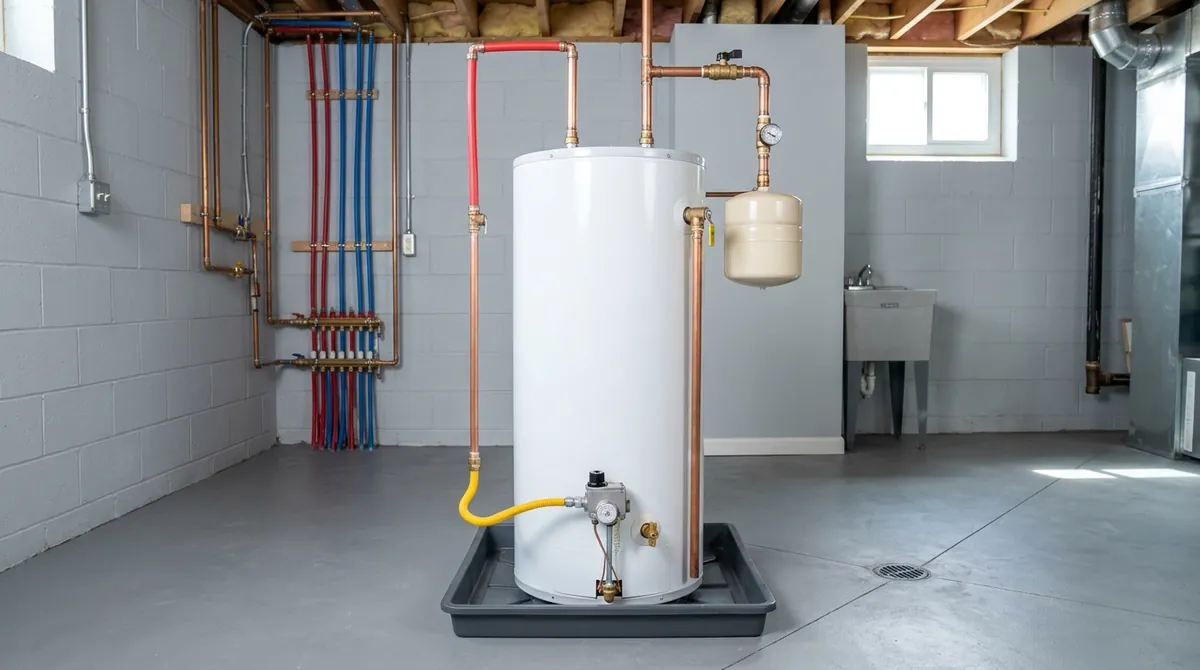
- Bringing older installs up to current requirements where needed, such as an expansion tank, a drain pan or a new shut-off.
- Setting and checking the relief valve and the temperature, then running the unit through a full heat cycle before we leave.
How to Compare Quotes
If you are getting more than one opinion, check that each one says:
- Where the leak is coming from, and how they confirmed it.
- Whether they are recommending repair or replacement, and why.
- On a replacement, the size and type of unit, and whether it suits your hot water use.
- What code items are included, such as an expansion tank or a new shut-off.
- Whether removal of the old unit is included.
- Whether water treatment was discussed, given the hard water here.
A quote that goes straight to a new heater without saying where the leak is has skipped the most important step.
Water Heater Leaking in Sioux Falls? Gold Standard Plumbing & Heating Is Ready to Help
Gold Standard Plumbing & Heating is locally owned, licensed, bonded and insured, and manufacturer certified. We find the actual cause of the leak first, then repair or replace with the reasoning laid out, so the next unit lasts longer than the last one. We work on tank and tankless water heaters across Sioux Falls, Brandon, Harrisburg, Tea and the surrounding towns. Read more about our water heater repair and replacement in Sioux Falls, or our water heater service in Brandon.
Call us at (605) 530-6950 or contact us. We answer weekdays from 7:30 am to 5 pm, and emergency calls are welcome within those hours.